Lesson 2 of 4 · 8 minutes
The Curse of Knowledge
Why thin or bloated expert content is not a verdict on the expert.
By the end of this lesson, you’ll be able to
- Diagnose thin or bloated SME content as compression rather than as a verdict on the expert
The better someone is at something, the harder it often is for them to explain it to a beginner. That is not a flaw in your SME. It is a property of expertise itself.
Forty decisions become one motion
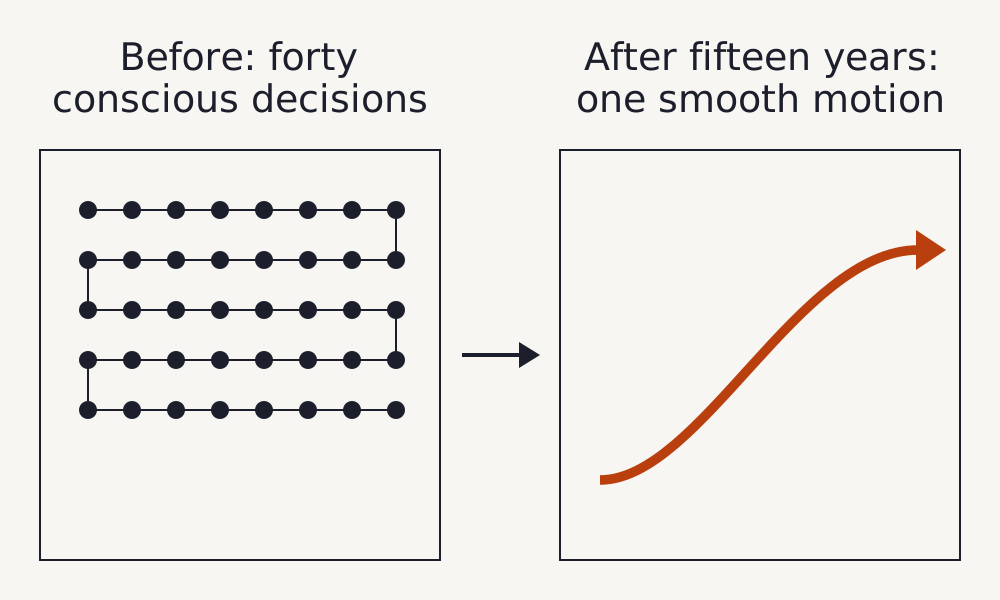
When someone does a task for fifteen years, the steps compress. What used to be forty conscious decisions becomes one smooth motion. Ask a veteran technician how she diagnoses a fault and she’ll say something like “you can just tell.” She is not being difficult. The knowledge is real, but it stopped being visible to her a decade ago.
A name for it
There is a name for this, the curse of knowledge, and it explains a lot of what you will see from experts. The term comes from Camerer, Loewenstein and Weber (1989), and Chip and Dan Heath made it popular in Made to Stick (2007). Once you know something, you can’t fully imagine not knowing it. For our work it means something specific: the expert is often the person least able to see what a beginner needs, and the most qualified to verify it.
You need them for accuracy. You can’t rely on them for sequence, emphasis or level. That split is the whole job.
Two symptoms, one cause
Over-explainer
Sends you everything. Forty pages, sixty slides, every exception and edge case, because from inside the expertise it is all connected and it is all important. Cutting any of it feels, to them, like lying to the learners.
Under-explainer
Sends you three bullet points for the most important topic in the course. Not because they’re lazy. Because after twenty years, those three bullets genuinely feel complete. Everything else is “common sense,” which is expert for “things I no longer remember learning.”
Two projects of mine
In a pharmaceutical project, my SMEs were research scientists. Brilliant people, zero teaching background. Their source material assumed you knew what a dozen acronyms meant and skipped steps that were obvious to them and to nobody else on earth. I spent half that project asking questions that felt embarrassingly basic. Those questions were the work. Every one of them surfaced something learners would have tripped on.
I once watched a junior designer inherit content from a compliance expert and build a sixty-slide course for pharmacy technicians that listed every regulation the expert had mentioned. Factually perfect. Completely unusable. A new hire can’t absorb sixty slides of regulations, and the expert never claimed they could. Nobody had asked the expert what mattered most, so everything shipped at equal weight.
Messy content is not a verdict on your SME, and it is not a verdict on you. It is raw ore. The refining is your job, and it is what Modules 3 and 4 cover.
When it isn’t compression
Your SME, a senior engineer, replied to your request the same day, offered to talk “whenever you need,” and sent three bullet points for the topic the project brief calls “the critical module.” What do you check first?
-
Whether he is disengaged: three bullets on the critical topic means he wants out, and you should escalate.
He replied the same day and offered to talk. Disengagement shows in the behavior around the content, and this behavior points the other way. Watch it anyway: if the offer to talk never turns into a call, that is new evidence.
-
Whether the steps compressed: ask him to walk you through the topic out loud and see what the three bullets expand into.
Same-day reply, an offer to talk, and three bullets that feel complete to him. That pattern fits compression, and the check is cheap: one conversation tells you whether forty steps live behind the three bullets.
-
Whether he is testing you: fill the gaps yourself and show him you know the subject.
Nothing here suggests a test, and filling gaps you don’t understand is how wrong procedures get into courses. Ask him to expand the bullets first.
Read the note under your choice, then try again.