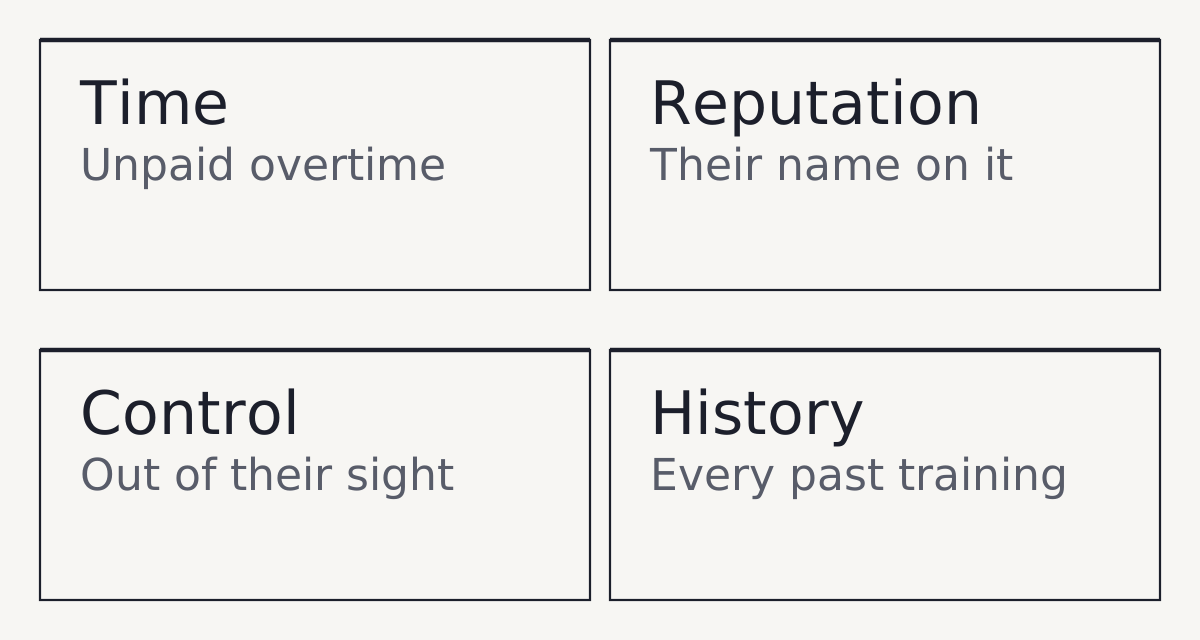
The four things an expert risks when they help you, and how to read them.
By the end of this lesson, you’ll be able to
Identify which of four stakes to check first, from an expert’s observable behavior
Draft a reply to a reluctant expert that checks the constraint and secures a workable next step
When a project starts, everybody asks what the SME knows. Almost nobody asks what the SME risks. But the risks drive the behavior you’ll spend the next eight weeks living with.
What you’re really asking for
Think about what you’re actually requesting when you ask an expert to help build a course. You’re asking for hours they don’t have, taken from the job they’re measured on. You’re asking to take their professional knowledge, change its form, and publish it where colleagues and strangers will judge it, with their name attached and the final wording out of their hands. And you are probably the third or fourth person in their career to show up with a process and a template and a smile.
Put that way, SME resistance stops looking like a character flaw. It starts looking reasonable.
That shift in your head is worth more than any template in this course.
The four stakes
These four are my working model, built from my own projects. It is not research. It is the four things I have learned to check, in the order I usually find them.
Time
Helping you is unpaid overtime. The SME’s real job didn’t shrink when your project started. When time is the dominant stake, you’ll see deflection, delays, one-line answers and meeting no-shows. None of it is about you.
Reputation
Their name goes on content they don’t fully control. If the course is wrong, or just embarrassing, they absorb the damage in front of the audience that matters most to them: their peers. When reputation is the stake, you’ll see nitpicking, heavy edits and resistance to simplification. Every simplification looks, to them, like a chance to be wrong in public.
Control
Your process takes their material and does things to it out of their sight. Experts who’ve been burned by that will demand approval over everything, rewrite your drafts back toward their original, or refuse to hand over material at all. People who demand approval over everything have often been misquoted before. Ask.
History
You inherit every bad experience this person has ever had with training, trainers and people who look like you. The vendor course that taught the wrong procedure. The workshop that wasted a day. The last ID who promised collaboration and delivered a template. You weren’t there for any of it, and you’ll pay for all of it until you prove otherwise.
Select each marker to explore.
A rough decoder
The stakes are invisible. The behavior is not.
What you see
Check first
Deflection and delay (“just work from the manual”)
Time
Nitpicking and rewrites
Reputation or control
Hostility, fresh anger about an old wound
History
Silence
Could be any of the four. Go find out.
Rough is the operative word. The decoder tells you what to check first, not what is true. You confirm by asking, usually at the kickoff. The kickoff questions are Module 2’s job.
Three fictional experts
Three fictional experts, one tab each. Each is a pattern you’ll meet. My own stories cluster in the industries I worked, so these are here to show the same stakes wearing other uniforms.
Surgeon
A chief of surgery is the SME for an operating room safety module. She rewrites every caption, questions every diagram, and escalates a disagreement about a checklist illustration to the chief medical officer. Exhausting, until you see the stake: residents she trains will quote this module back to her, and any error surfaces at the morbidity conference with her name attached. Reputation. What settled it was an accuracy gate she could trust, not better captions.
Founder
A nonprofit founder is the SME for volunteer onboarding. Every draft comes back rewritten into the story of how she started the organization in her garage. The training needs procedures, and she keeps deleting them. The stake is history and control together: the organization is her biography, and handing its story to a contractor feels like losing custody of it. Keeping her origin story in the opening, on purpose and with her byline, is what let the procedures stay in.
Officer
A government program officer gives you exactly fifteen minutes a month and answers only the question you asked. Nothing about you: it’s audit season, her team is down two analysts, and your course is the eleventh most important thing on her desk. Time, purely. Smaller asks on her calendar’s terms got further than better questions ever did.
Which stake is talking?
Five behaviors. For each one, pick every stake the behavior points to. Three of them point to one stake. Two point to two, a direct one and one usually underneath, and those are marked “select all that apply.” Use the decoder, and remember it tells you what to check first, not what is certainly true. You get a short reason after each call.
Pushes back on every simplification: “Say it that way and a peer will call it wrong.”
Time
Arguing over wording costs him time, and he is spending it. Check reputation first. Time can still be real underneath.
Reputation
He named it: a peer will call it wrong. Each simplification looks like a chance to be wrong in public. Check reputation first.
Control
Close. He isn’t asking to decide what leaves his hands; he’s protecting how it sounds to peers. Check reputation first and watch for control.
History
Nothing here points to an old training. He may have one, so ask at the kickoff. The direct signal is reputation.
Check the decoder, then try again.
Rewrites your draft back toward his original wording, every round.
Time
Rewriting every round is hours of his work, and he is spending them. Check control first.
Reputation
Nothing here is about peers or his name. The move itself is pulling the material back to where he can steer it. Check control first.
Control
He is pulling the material back to where he can see and steer it. Check control first: a review gate he trusts usually settles it.
History
No old wound is named. He may have one, so ask. The direct signal is his wording, which is control.
Check the decoder, then try again.
“This won’t change anything. The last one didn’t either.”
Time
Nothing about hours. This is about what happened before.
Reputation
He isn’t worried about looking wrong. He has already decided it won’t work, and he told you why: the last one.
Control
He isn’t trying to steer it. He’s writing it off.
History
“The last one” is the tell: a past training, named. Check history first, and ask what it did.
Check the decoder, then try again.
Interrupts your questions, twice, to ask exactly who will see her content before it publishes. This one points to two stakes.
Time
She is spending minutes on process questions, so check control first. Time can still be real; it just isn’t what this sentence is about.
Reputation
Usually underneath. Who sees it matters because her name is on it. Check control first, then reputation.
Control
The direct signal. She wants to decide what leaves her hands. Check control first.
History
Possible, but nothing here names a past training. Ask at the kickoff. The direct signal is control.
Pick both stakes this points to, then try again.
“I can give you fifteen minutes. And I’ll be honest, this is the third onboarding course I’ve been asked to fix in four years.” This one points to two stakes.
Time
The direct signal. She named the minutes. Check time first.
Reputation
Not in what she said. Her name and her peers aren’t mentioned. Check time and history before you guess at this one.
Control
She isn’t asking to approve anything. She’s telling you about her hours and about the last three courses.
History
Usually underneath. Three courses she had to fix is a past that is still costing her. Ask what the last ones got wrong.
Pick both stakes this points to, then try again.
Silence isn’t on the list. Silence doesn’t sort. It could be any of the four, which is why the decoder’s answer for silence is “go find out.”
Ray’s email
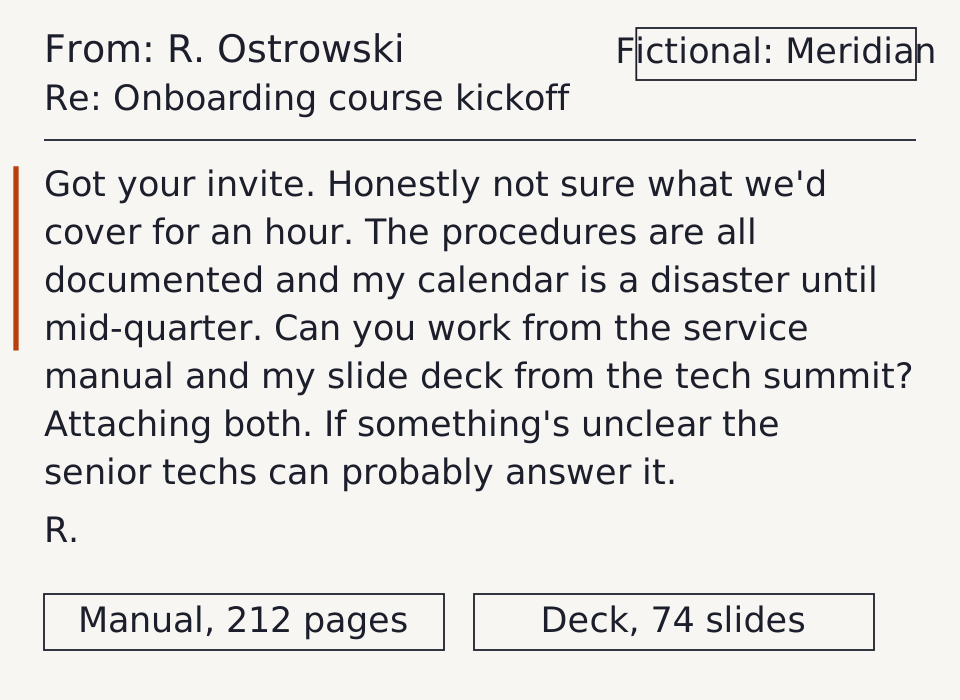
Here’s what the stakes look like in practice, on the Meridian case. Ray Ostrowski is the SME, an engineering manager with eighteen years at the company, sixteen of them on the road as a field tech. Your kickoff invitation asked for a thirty-minute call. It has sat unanswered for two days. This morning, this arrived.
From: R. Ostrowski
Re: Onboarding course kickoff
Got your invite. Honestly not sure what we’d cover for an hour. The procedures are all documented and my calendar is a disaster until mid-quarter. Can you work from the service manual and my slide deck from the tech summit? Attaching both. If something’s unclear the senior techs can probably answer it. R.
Attachments: Manual, 212 pages. Deck, 74 slides.
Reading Ray’s email
First pass. I’ll read Ray’s email and mark what I notice.
“Not sure what we’d cover for an hour”
Two things in one line. He read the invite as costing him an hour; I asked for thirty minutes. And “not sure what we’d cover” tells me he thinks the content already exists in finished form. That looks like the under-explainer pattern from Lesson 2, and I haven’t met him yet, so it is a guess to check.
“My calendar is a disaster until mid-quarter”
Time stake, said plainly. People usually hand you one stake for free. It is rarely the whole story.
“Can you work from the service manual and my slide deck?”
Deflection. The decoder says deflection means check time first, and that fits. Now look at what he attached: 212 pages plus 74 slides, within two days. The attachments show he responded with resources. They don’t yet tell me whether he’ll take part in review. My read, which I’d check at the kickoff: he wants this course to be right, and he would rather not be in the room while it happens.
The attachments: a 212-page service manual, and 74 slides, about half of them photos of analyzer internals with no captions. Select each marker to see my read.
The project brief
Now the project brief. Three years ago, corporate rolled out a vendor-built course that taught a power-down sequence two revisions out of date. Ray’s team spent a year fielding calls from hospital staff who noticed techs doing it “the training way.” Ray personally wrote the correction memo. Nobody at corporate responded. There’s the history stake, and it’s a big one.
And notice how it got summarized around the office: “Ray hates training.” That summary is wrong in a useful way. Ray hates what training did to his team. Different thing.
Ray’s map
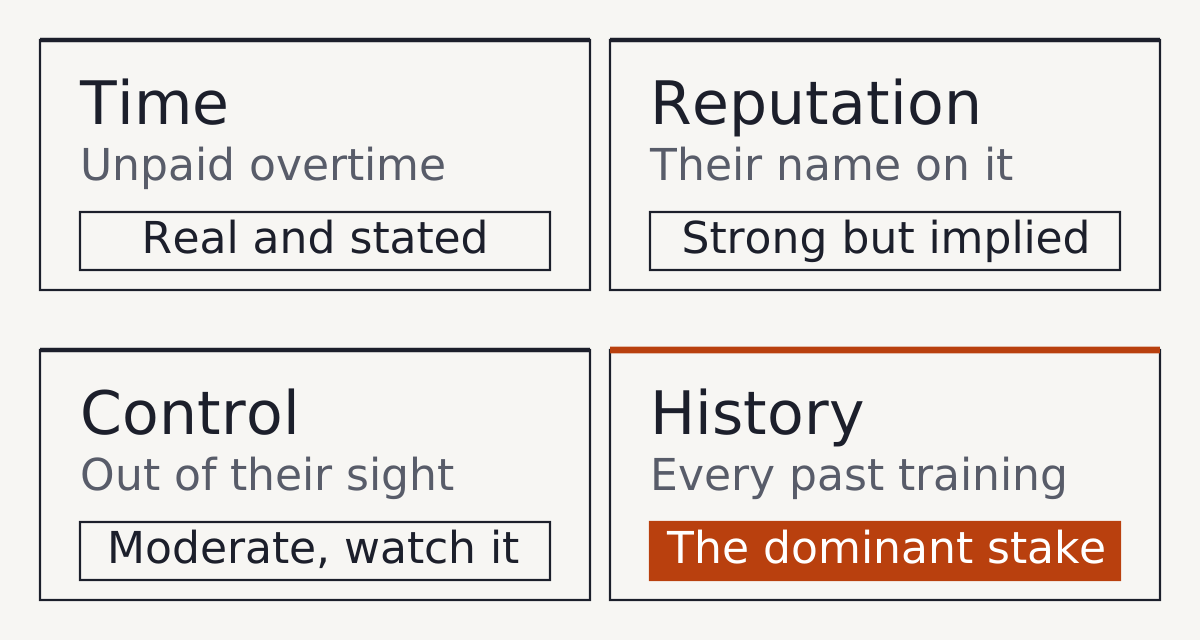
Drag the handle to see my read of Ray’s map.
Reading Ray’s map
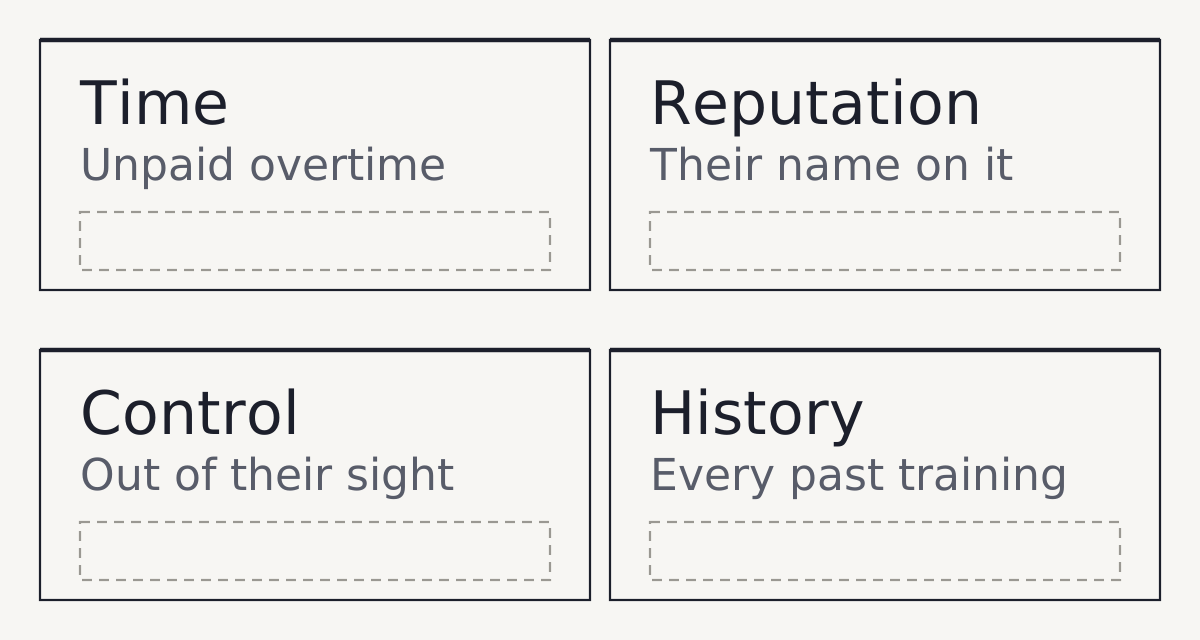
Stake
How strong
What it means for Ray
Time
Real and stated
Manager workload plus field escalations. Availability will come in small windows, on his terms.
Reputation
Strong but implied
“If Ray says the course is right, it’s right.” His standing with his own techs is the currency here. A course that makes his team look stupid spends it.
Control
Moderate, watch for it
He sent materials instead of offering conversation. He may try to review everything at the end rather than take part along the way.
History
The dominant stake
Documented, specific, never resolved. He isn’t guessing that training goes wrong. He has a memo.
Write your reply to Ray
Before you see mine, write the opening of your reply to his email. Check it against four things:
It separates what you saw from what you assume.
It acknowledges the constraint he stated.
It makes one small, bounded ask.
It says what the ask buys him.
What you write is saved only in this browser and never sent anywhere.
“Ray, thanks for the manual and the deck. They’re exactly what I need to start, and I’ve read the summit slides. I know mid-quarter is brutal, so I’m not asking for the hour. Could I have twenty minutes, on your calendar’s terms, for the one thing the manual can’t tell me: what the last training got wrong for your techs, so this one doesn’t repeat it?”
My read of three options
Three ways I could open my reply to Ray. Compare them with what you wrote.
Option one: “Our process requires a kickoff meeting with all SMEs.”
Option two: “The manual and deck are a great start, I’ll build from these and send you a draft.”
Option three: “The deck and manual are exactly what I needed to start. Twenty minutes with you buys the one thing they can’t tell me: what the last training got wrong for your techs, so this one doesn’t repeat it.”
Think about it: with Ray’s map in front of you, which of these does it rule out, and which is closest to yours?
Option one: True, and dead on arrival. It answers a history wound with more process.
Option two: Feels accommodating. It books me a review ambush in week four, because he sees nothing until it’s finished.
Option three: Twenty minutes, not the thirty I asked for and not the hour he feared: fits the time budget. Names the history stake without psychoanalyzing him. Makes the meeting about protecting his team, which is the stake under everything else. Ten minutes with the map and my reply stopped being a form letter.
Three rules for the map
The map is a thinking tool, not a personnel file. Keep it for yourself, and keep any project notes factual and inside your organization’s rules. “Replied after four days, asked twice who approves wording” is a note you can defend. “Ray fears being embarrassed” is a guess, and a guess like that in a shared folder becomes the history stake for the next designer. Map patterns, not moments. One late reply is a Tuesday. Three late replies with shrinking answers is a signal, and if you catch yourself psychoanalyzing a single email, close the map and go do something else. And skip the map when the collaboration is already working. A responsive, honest, engaged SME doesn’t need a diagnosis, and running one anyway turns a healthy relationship into a specimen. The map doesn’t explain away project problems, either: if content is late because the project has no executive support, no stakes map fixes that.
A normally responsive SME misses one content deadline. According to this module, you should:
Fill out a stakes map to diagnose the resistance underneath.
The map is for repeated behavior; psychoanalyzing a single event turns a healthy relationship into a specimen.
Treat it as noise unless it repeats, and nudge normally.
One slip is a Tuesday. Nudge like a normal colleague and move on.
Raise it gently in your next one-on-one as a pattern you’re seeing.
Calling one instance “a pattern” is inaccurate and mildly insulting, and it damages the trust you’re trying to build.
Read the note under your choice, then try again.
Two weeks in, an SME has approved every draft of your outline, but every time you send a new section he asks for “one more look from my team before it goes anywhere.” Which stake do you check first?
Time: he is short on hours and stalling.
A time problem usually looks like slow replies and short answers. He is replying quickly and asking for more review, which costs him time, so check control first. Time can still be real alongside it.
Control, with reputation underneath: he wants to decide what leaves his hands.
Repeated requests to see material before it goes anywhere are control signals, with reputation usually underneath. Check control first: a review gate he trusts, agreed up front, usually settles it.
History: a specific past training burned him.
Possible. Nothing he has said names a past training, so check control first and ask about history at the kickoff. A burn he hasn’t mentioned is still possible.
Read the note under your choice, then try again.
Reflection: Read one expert. Think of an expert you’ve worked with, or use Ray if you haven’t yet. Which stake do you think was driving their behavior? Write two or three sentences: the behavior you observed, the stake you suspect, and one thing you’d do differently in your next interaction because of it. Behavior only. “Slow to reply” is evidence. “Doesn’t care” is a conclusion. What you write is saved only in this browser and never sent anywhere.
“My SME on a compliance refresher answered every question with the shortest possible sentence and twice asked who would be approving the final wording. I read that as control with reputation underneath, and I’d check that before time: she was spending time on process questions, so time didn’t look like the first thing to check. Next time I’d show her the review plan in the first meeting, before she has to ask, so the approval gate is visible from day one.”