Lesson 4 of 4 · 15 minutes
Translator, Advocate, Driver
What you are in this relationship, and what to do with a reluctant expert.
By the end of this lesson, you’ll be able to
- Choose the translator, advocate and driver functions over the three postures that fail, and apply them to a reluctant expert
Now flip the table around. You know what the SME risks. What exactly are you, in this relationship? I’ve watched new instructional designers default into three postures, and all three fail.
Three postures that fail
Stenographer
Whatever the expert says goes in the course, formatted nicely. It feels respectful. It leaves the learners with no one representing them, and the course becomes a well-designed data dump.
Adversary
You know learning science, they know content, and every meeting becomes a negotiation over territory. The advocacy is real. What’s missing is translation: the expert hears their material being overruled instead of carried across to the learner. It produces courses that experts refuse to review and quietly bad-mouth. You can’t build a course against your only source of truth.
Ghost
You take the material, disappear for three weeks, and come back with a finished product for approval. It feels efficient. It’s a trap. The expert, cut out of the process, experiences your draft as a surprise, and surprises get defended against. Some of the worst review blowups in my career grew in exactly this silence.
The posture that works is not a compromise between those three. It is a different job with three functions.
One job, three functions
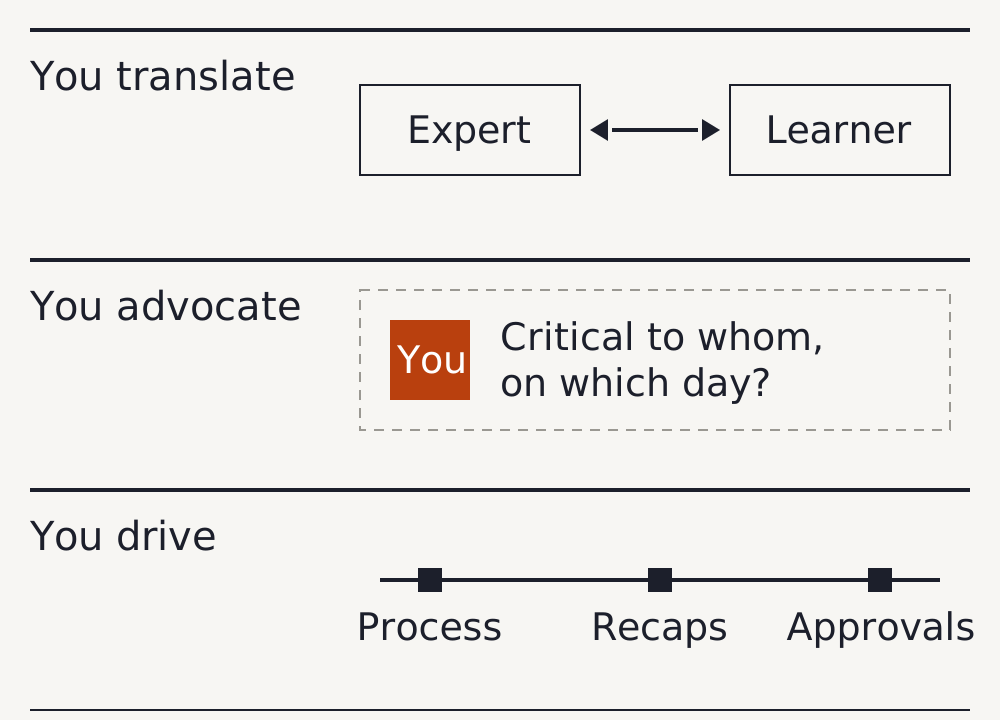
You translate. Between the expert’s compressed knowledge and the learner’s day one. Both directions: you also translate the learner’s reality back to the expert, who usually hasn’t been a beginner in decades.
You advocate. For the learner, in rooms the learner is never in. When the expert says all sixty slides are critical, you’re the one person on the project whose job is to ask “critical to whom, on which day?”
You drive. The project, so the expert doesn’t have to manage it. You run the process, send the recaps, chase the approvals, and make contributing to your course the easiest professional obligation on their calendar. Experts don’t resent process. They resent process they have to manage.
Where your standing comes from
Which posture is your default?
You probably have a default. Which of these complaints do you hear most?
Which posture does each complaint point to?
- “You’re the expert, whatever you think”
- Stenographer
- Experts decline to review your drafts, then criticize the course after launch
- Adversary
- Review blowups
- Ghost
“You’re the expert, whatever you think” means you’ve drifted stenographer. Experts who won’t review and criticize after launch mean adversary. Review blowups mean ghost. I still check, twenty-five years in.
Think about which posture would produce each complaint, then try again.
“Just build it from my deck”
Fictional. B2B software. Characters invented.
You’re three days into a customer-onboarding course at a software company. Your SME is Priya Raghavan, the company’s most senior solutions engineer: twelve years, and the person account teams ask for by name when an implementation is hard. Your kickoff invite has sat for two days. This morning she replied. The deck she mentions has 74 slides, about half of them screenshots with no speaker notes.
“I don’t really have time for meetings on this. I’m attaching my deck from the sales enablement session, everything’s in there. Just build it from that and I can look at it when it’s done.”
- Take the deck and run. Thank her, build from the deck for three weeks, and send her the finished draft to review.
- Hold the process line. Tell her a kickoff is required for every SME-supported project, and propose three meeting times this week.
- Shrink the ask. Call the deck a strong start and ask for twenty minutes, on her clock, about what past onboarding got wrong.
Scene 2: Week three
You send the finished draft. Her reply comes back in forty minutes: “Thanks. I’ll read it when I can. Before I do: did anyone tell you what happened with the last course somebody built from my material?”
- Ask. “Nobody did. What happened?” Then offer to hold the draft until she has twenty minutes to tell you.
- Reassure. “I heard it didn’t go well. This one’s different, I promise. Have a look and send me your comments.”
- Point at the process. “The draft has been through our full design and QA process, so it should be in good shape.”
Scene 2: The guarded twenty minutes
She accepts a twenty-minute slot on Tuesday and joins six minutes late, laptop open, answering messages, so you have fourteen minutes. Cordial and closed: one-line answers, eyes on the clock. Your prepared questions are landing like an audit.
- Push through the list. You prepared twelve questions, there are eleven left, and you have fourteen minutes.
- Drop the list. Ask one thing: “Walk me through the last implementation you were proud of. What did the customer struggle with?”
- Cut it short. “I can tell this week is crushing you. I’ll work from the deck and send questions as they come up.”
Scene 2: The guarded twenty minutes
Two days of silence. Then: “Fine. Thursday 4:40, I have a hard stop at 5.” Not warmth. A crack in the door. She joins six minutes late, so you have fourteen. Cordial and closed: one-line answers, eyes on the clock. Your prepared questions are landing like an audit.
- Push through the list. You prepared twelve questions, there are eleven left, and you have fourteen minutes.
- Drop the list. Ask one thing: “Walk me through the last implementation you were proud of. What did the customer struggle with?”
- Cut it short. “I can tell this week is crushing you. I’ll work from the deck and send questions as they come up.”
Scene 3: The real objection surfaces
You’re nine questions in. She glances at the clock, and then says something you didn’t ask about.
“Look. Every project says that. Required kickoff, structured review, sign-off at every stage. Then the course comes out wrong anyway and I’m the one answering the tickets for a year. No offense, but I don’t have a year for another process.”
- Reassure. “That won’t happen this time. I’ll make sure of it. You have my word, and I don’t say that lightly.”
- Treat it as the kickoff. “Then this is what we should talk about. Which course, and what did it get wrong?” Take notes, propose a review agreement.
- Defend the profession. “That’s exactly why this project follows a proper instructional design process, with structured review and quality checkpoints at every stage.”
Scene 3: The real objection surfaces
Eight seconds of silence. Then she turns her laptop around, pulls up an architecture diagram, and talks for nine minutes without stopping. Then she stops mid-sentence.
“Look. Every project says that. Required kickoff, structured review, sign-off at every stage. Then the course comes out wrong anyway and I’m the one answering the tickets for a year. No offense, but I don’t have a year for another process.”
- Reassure. “That won’t happen this time. I’ll make sure of it. You have my word, and I don’t say that lightly.”
- Treat it as the kickoff. “Then this is what we should talk about. Which course, and what did it get wrong?” Take notes, propose a review agreement.
- Defend the profession. “That’s exactly why this project follows a proper instructional design process, with structured review and quality checkpoints at every stage.”
Scene 3: The real objection surfaces
You’re nine questions in. She glances at the clock, and then says something you didn’t ask about.
“Look. The last course somebody built from my material was embarrassing. I spent a year answering tickets from customers it confused, and I ended up re-teaching everything on live calls anyway. No offense, but I don’t have another year for that.”
- Reassure. “That won’t happen this time. I’ll make sure of it. You have my word, and I don’t say that lightly.”
- Treat it as the kickoff. “Then this is what we should talk about. What did it get wrong?” Take notes, propose a review agreement.
- Defend the profession. “That’s exactly why this project follows a proper instructional design process, with structured review and quality checkpoints at every stage.”
Scene 3: The real objection surfaces
Eight seconds of silence. Then she turns her laptop around, pulls up an architecture diagram, and talks for nine minutes without stopping. Then she stops mid-sentence.
“Look. The last course somebody built from my material was embarrassing. I spent a year answering tickets from customers it confused, and I ended up re-teaching everything on live calls anyway. No offense, but I don’t have another year for that.”
- Reassure. “That won’t happen this time. I’ll make sure of it. You have my word, and I don’t say that lightly.”
- Treat it as the kickoff. “Then this is what we should talk about. What did it get wrong?” Take notes, propose a review agreement.
- Defend the profession. “That’s exactly why this project follows a proper instructional design process, with structured review and quality checkpoints at every stage.”
You take visible notes while she tells you what the last course did to her team. Then you propose a review agreement and write it down in front of her: she sees the outline before you build; each technical section goes to her first, with a date on it; and if a date passes without her, you and her manager decide together who signs off on accuracy instead. You don’t own final approval, and you say so. She looks at your notes, then at you. “Nobody asked me that after the last one either.” The remaining minutes run past her hard stop, at her choice. On Friday, unprompted, she sends three annotated screenshots “for the sections people always get wrong.”
Debrief: Priya’s “I don’t have time” was three stakes wearing one sentence: real time pressure, a documented burn, and a loss of control she was refusing to repeat. The deck was her compromise, help without exposure. The move that mattered was the last one. When the real objection surfaced, you treated it as the agenda, asked what happened, and answered the control stake with a review agreement she can see: who approves technical accuracy, by when, and who decides if she’s unavailable. She will believe a gate she can see. She would not have believed “this time is different.”
She says “okay,” and the meeting ends on time. You build from the deck. She answers direct questions by email, a line or two each, a day or two late. The course ships on time and is fine. In review, she corrects eleven things you couldn’t have known, politely, and never volunteers a twelfth.
Debrief: Nothing here failed loudly, and that’s the problem with this path: it feels like a win. She told you what the last course did to her, and you answered with a promise. Kind, and she has heard it before, from someone with a title very much like yours. She will believe a review gate she can see. She will not believe “this time is different.” Next time, pair the kindness with structure: an outline before the build, and an agreed approver for technical accuracy, with dates, before anything ships.
You leave with the deck and a promise to send questions. You send nine over three weeks; four come back answered, one line each. The course ships on time and is fine. In review she sends back fourteen corrections and a note: “Most of these are in the deck if you look.” You never find out what the last course got wrong, because you left the room before she could tell you.
Debrief: Kindness is right. Surrender is not the only kind. You read the time stake correctly and then gave up the meeting instead of shrinking it. One concrete question, “walk me through the last implementation you were proud of,” would have cost her three minutes and handed you the real agenda. Shrinking the ask beats abandoning it.
She tells you: a year of tickets from confused customers, and re-teaching everything on live calls. You hold the draft, get the twenty minutes, and rebuild four sections around what she tells you. The course ships two weeks late. She’s cordial about it, and never quite relaxed.
Debrief: You asked the right question, three weeks after it would have been cheap. Building from the deck alone is the ghost posture: she saw nothing until it was finished, and by then the draft was a surprise to defend against. The question that rescued the project was available on day one, for the price of twenty minutes. Next time, ask it before you build.
Week four. Priya returns your draft with 61 comments, a third of them variations of “this is not how it works.” The rework costs more than five kickoffs. She now believes the project confirms what she suspected: training people guess. Somewhere in the building, her version of this story is being told at lunch, and you’re not the sympathetic character in it.
Debrief: You built from the deck alone, and that is the ghost posture: she saw nothing until it was finished, and surprises get defended against. Then she handed you the real agenda in one question, and you answered it with a promise or a process instead of asking what happened. The deck was never the content. It was the visible half of twelve years of judgment, and the invisible half is where courses live. The fix is not confidence. It’s twenty minutes, one concrete question, and a safeguard she can check.
Week four. Your draft goes to her for review and sits there for nine days. Then her manager writes to yours: Priya says the course needs a full rewrite and doesn’t have the bandwidth to explain why in comments. You get a one-hour meeting, the first real one, in which she walks you through everything it gets wrong. The rework costs more than five kickoffs, and the version going around her team is that you turned out to be the same as whoever built the last one.
Debrief: She told you what process did to her team, and you answered with “proper process.” Process vocabulary is what burned her. Answering a wound with the instrument that made it is the fastest exit from the room, and it filed you under the same category as whoever built the last embarrassing course. Authority did the work that reading the stakes should have done. The fix is not confidence. It’s one concrete question and a safeguard she can check.
What happened in my career
This is a composite: two experts merged, details changed. The Priya in my career was an expert who answered my kickoff invite with “everything you need is in the files.” The files were extensive and the gaps were enormous, and the person was carrying exactly this kind of burn from a previous course. What turned it was small asks on their clock and one safeguard made structural: nothing ships without their stamp. The same person who dodged my first three emails ended up sending me corrections at eleven at night, unasked, because the course had quietly become theirs too. That arc, reluctant to invested, is the thing I have seen most often with experts.
You’re new to the field. Your SME has eighteen years of standing. Your most reliable source of credibility in week one is:
-
Demonstrating your knowledge of learning science and instructional models.
Pedagogy vocabulary reads as jargon and rank-pulling, especially to an expert who’s been burned by process people before.
-
Agreeing with their content decisions until trust is established.
Agreement you don’t mean is deferred conflict; it resurfaces at review, the most expensive place to have it.
-
Preparation and reliable process: knowing their material, tiny fast deliverables, recaps within 24 hours.
You can’t outrank expertise, and you don’t need to. Reliability is what an expert needs from you, and it’s fully in your control from day one.
Read the note under your choice, then try again.
An SME says “cut the safety caveats, the audience knows all that,” and the ID replies “you’re the expert” and cuts them. Which posture is the ID taking?
-
Translator.
A translator would check what the caveats protect and whether the newest learner in the audience actually knows them.
-
Stenographer.
Transcribing the expert’s preference without weighing the learner’s need is stenography, even when it feels like respect.
-
Advocate.
An advocate would ask “the audience as of which day?” The expert is remembering colleagues, not new hires.
Read the note under your choice, then try again.
Before you go
How consistently do you read an SME’s resistance or silence as information, and adjust your approach instead of just enduring it?
You answer the email as written and move on. Next time, before you reply, write down the behavior in it and name the stake you’d check first. The decoder in Lesson 3 is the starting point.
You read it sometimes. The gap is usually evidence. Write down the behavior before you decide what it means.
You already do this. The thing to watch is the day you stop writing the behavior down first.
One thing to take with you
Before you send a reply to a reluctant expert
- It separates what I saw from what I assume.
- It acknowledges the constraint they stated.
- It makes one small, bounded ask.
- It says what the ask buys them.
- It names the review gate I can actually promise: who approves technical accuracy, by when, and who decides if they are unavailable.
That’s the module
You finished it. Thank you.
On Monday, take the last email from an expert that annoyed you. Write down the behavior in it, not your conclusion about it, and name the stake you’d check first. Then change one line of your reply because of it. That is the whole habit.
Module 2, The Kickoff, is planned and not built. It is the twenty minutes with Ray: the seven questions to ask, in order, and the one-page brief you write before you leave the room. Whether I build it depends on whether people want it. If you would use it, tell me in one line at dean@deanahlgren.com. That’s the only ask I have.